
 Standardit
Friction is something we encounter every day—whether it’s the grip of your shoes on a wet floor or the smooth glide of a package on a conveyor belt. But how do we actually measure it? That’s where a coefficient of friction tester comes in. This tool helps determine how much force it takes for one surface to move across another. It may sound simple, but the data it provides has significant implications for industries such as packaging, manufacturing, and materials engineering. In this article, we’ll explore what the coefficient of friction means, how testers work, the formulas behind them, the difference between static and kinetic friction, and what factors influence the price of these testers.
What Is the Coefficient of Friction?
The coefficient of friction is a measurement that describes how much grip or slip exists between two surfaces. Represented by the Greek letter “μ” (mu), it’s a ratio that compares two forces—so it doesn’t have any units. In essence, it tells us how resistant one surface is when sliding over another.
There are two main types: static friction and kinetic friction. Static friction deals with the force required to start movement, like when you push a heavy box that’s not yet moving. Kinetic friction, on the other hand, describes the resistance once the object is already sliding. Usually, the coefficient of static friction is higher because it takes more effort to initiate motion than to maintain it.
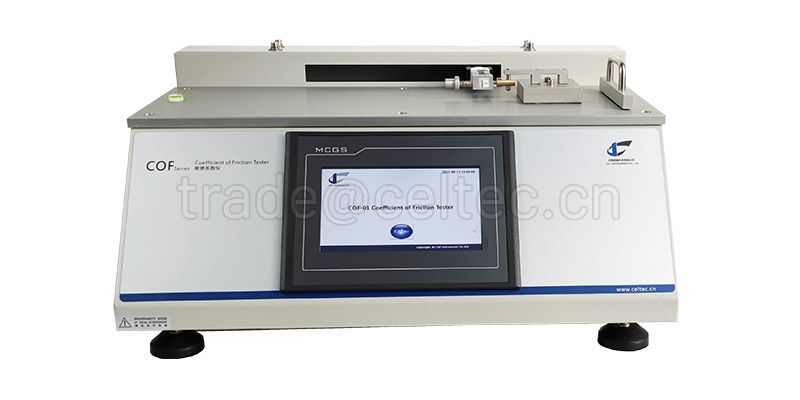
How Does a Coefficient of Friction Tester Work?
A coefficient of friction tester is designed to measure both static and kinetic friction precisely. The setup is simple yet effective. A sample material—such as film, paper, or metal—is placed on a flat test surface. A weighted sled with another sample attached is positioned on top. The sled applies pressure between the two surfaces, simulating real-world contact.
The tester then pulls the sled at a controlled speed using a motor or pulley system. Sensors measure two forces: the peak force required to start movement (static friction) and the steady force required to keep it moving (kinetic friction). These forces are recorded and used to calculate the friction coefficients.
Modern testers often feature digital displays or computer interfaces that automatically generate graphs showing how friction changes during movement. This allows for clear comparison between materials and precise quality control.
The Coefficient of Friction Formula
The calculation itself is straightforward. The formula is:
μ = F / N
Here, “μ” is the coefficient of friction, “F” is the measured frictional force, and “N” is the normal force—the weight or pressure pressing the two surfaces together.
For static friction, you use the maximum force required to start the sled moving. For kinetic friction, you take the average force while it’s in steady motion. Because both are forces, the result is a dimensionless number—typically between 0 and 1, although it can be higher for extremely sticky or rough surfaces.
For example, if it takes 5 newtons of force to move a 10-newton sled, the static coefficient is 0.5. If it takes 3 newtons to keep it sliding, the kinetic coefficient is 0.3.
Static vs. Kinetic Friction
Static friction is the resistance that must be overcome to start an object moving. Imagine trying to push a piece of furniture—at first it resists, because the surface contact is “locked.” Once you push hard enough to break that resistance, motion begins.
Kinetic friction occurs after movement starts. Once the object is sliding, less force is usually needed to keep it moving because the surfaces are no longer fully locked together.
In short, static friction prevents movement, and kinetic friction controls movement. A friction tester measures both, helping engineers understand how materials behave in real-world applications.
Why Use a Coefficient of Friction Tester?
These testers are essential in multiple industries because friction influences performance, safety, and efficiency.
In packaging, friction determines how materials like plastic film or paper behave during processing and stacking. Too much friction can jam machines, while too little can cause slipping.
In manufacturing, friction testing helps engineers choose or design materials that perform well without unnecessary energy loss or wear. For example, in conveyor systems or tire design, the right balance between grip and smooth movement is vital.
In construction and safety products, measuring friction ensures that flooring, coatings, or footwear provide adequate traction to prevent accidents.
The data obtained from these tests is not just numerical—it’s a foundation for improving product design, safety, and production efficiency.
What Influences the Price of a Coefficient of Friction Tester?
The cost of a coefficient of friction tester depends on several key factors:
Features and Automation: Basic manual testers measure force directly, while advanced models include motorized control, variable speed settings, and data analysis software. More automation and precision increase the cost.
Testing Capacity: Some testers are designed for lightweight materials, while others can handle heavy or large samples. Higher capacity generally means a higher price.
Build Quality: Durable materials and reliable components add to the cost but improve long-term stability and accuracy.
Compliance Standards: Testers that meet international standards, such as ASTM or ISO, are calibrated for accuracy and consistency, often making them more expensive.
Prices range from a few hundred dollars for basic manual testers to several thousand for fully automated systems with digital reporting.
Typical Coefficient of Friction Ranges
Different material combinations have different friction characteristics. For example, wood on wood typically has moderate friction, rubber on concrete provides high traction, and plastic film on metal tends to slide easily. The exact values can vary depending on surface texture, cleanliness, and environmental factors like humidity.
Wrapping It Up
A coefficient of friction tester is far more than a simple instrument—it’s an essential tool for understanding how materials interact. By accurately measuring both static and kinetic friction, it helps manufacturers optimize processes, ensure safety, and improve product performance.
The concept may be simple, but its impact spans countless applications—from packaging lines to construction sites. Next time you slide something across a surface, remember that behind that smooth motion lies a world of science, precision, and testing technology.
Choosing the Right Coefficient of Friction Tester
If you’re considering investing in a friction tester, focus on factors such as accuracy, testing range, automation level, and compliance with relevant standards. It’s best to work with a reliable testing-equipment supplier who can help you select a model that fits your specific materials and budget. A well-chosen tester will provide consistent, precise data—helping you improve quality control and ensure product reliability.


 Suomi
Suomi  English
  العربية
  Български
  Čeština
  Dansk
Dansk  Deutsch
  Ελληνικά
  Español
  Eesti
Eesti  Français
  Magyar
  Bahasa Indonesia
  Italiano
  日本語
日本語  한국어
한국어  Lietuvių kalba
  Latviešu valoda
  Norsk bokmål
  Nederlands
  Polski
  Português
  Română
  Русский
  Slovenčina
  Slovenščina
  Svenska
  Türkçe
  Українська