
Introduction to Pressure Decay Leak Testing
Pressure decay leak testing is one of the most widely used methods in manufacturing production lines. This method is simple, cost-effective compared to helium testing, and easy to automate, making it a preferred choice in various industries.
How Does Pressure Decay Leak Testing Work?
The pressure decay method involves filling a test component with pressurized air. Once the desired pressure is reached, the component is isolated from the air supply and allowed to stabilize. A sensor then measures any pressure drop over a set time.
Key principle: A decrease in pressure indicates the presence of a leak. The rate of pressure drop determines the severity of the leak. If no pressure change occurs, the component is considered leak-free.
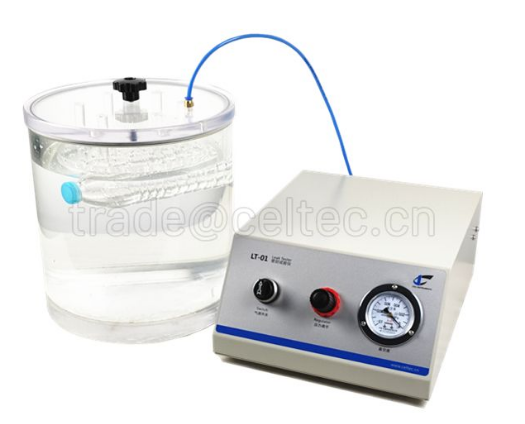
Advantages of Pressure Decay Testing
Highly Accurate: Detects even the smallest leaks.
Cost-Effective: Uses air instead of expensive gases like helium.
Versatile: Applicable for both positive and negative pressure testing.
Broad Industry Applications: Used in automotive, medical, packaging, and industrial manufacturing.
Pressure Decay Testing Applications & Industries
Pressure decay leak testing is used across various industries, including:
Automotive – Fuel system components, radiators, and airbag systems.
Medical – Medical tubing, syringes, and sealed containers.
Packaging – Sealed food and beverage containers.
Industrial Manufacturing – Hydraulic and pneumatic components.
Pressure Decay Testing Procedure: Step-by-Step
1. Cartridge Installation & Wetting
Ensure all components are available.
Install the cartridge into the housing, securing all fittings.
If using a pre-wetted cartridge, proceed to testing.
To wet the cartridge, open valves to allow fluid flow and remove air bubbles.
2. Performing the Pressure Decay Test
Ensure all valves are initially closed.
Connect a regulated air or nitrogen source.
Slowly increase the pressure to the specified test value.
Close the valve and allow stabilization.
Measure pressure drop over a set time (typically 10 minutes).
If pressure drop is below the threshold, the component passes.
Pressure Decay Test Formula
The pressure decay rate can be calculated using the formula:
DP = D * T * Pa / V
Where:
DP = Maximum allowable pressure drop.
D = Diffusion rate limit.
T = Test duration in minutes.
Pa = Atmospheric pressure (14.7 psi).
V = Volume of test apparatus.
Common Issues and Troubleshooting
1. Air Leaks in Plumbing
Ensure all connections are airtight. Perform regular system leak checks.
2. Marginal Failures
Re-wet the cartridge and retest if necessary.
3. Incorrect Cartridge Installation
Ensure O-rings are undamaged and properly seated.
결론
Pressure decay leak testing is a reliable, cost-effective, and widely adopted method for detecting leaks in manufacturing and industrial applications. By following the correct procedures and troubleshooting potential issues, manufacturers can ensure product integrity and safety.
Our well-equipped facilities and excellent quality control throughout all stages of manufacturing allow us to guarantee complete satisfaction to buyers of Heat Seal Tester,Leak Test Equipment Manufacturer,Leak and Seal Strength Tester,China Test Equipment,Material Test Equipment,Custom Testing Equipment,Tensile Tester,Vacuum Leak Tester,Textile Testing,Coefficient of Friction Tester,Electronics Test
이 제품에 대한 자세한 정보가 필요하시면 언제든지 문의해 주세요. 다른 인기 제품을 추천해 주세요: Gross Leak Tester Equipment, Gross Leak Tester Equipment Testing, Gross Leak Tester Equipment Testing, 젤보 플렉스 테스터 제조업체, 젤보 플렉스 테스터 제조업체, 젤보 플렉스 테스터 공급업체, Gelbo Flex Tester China, 젤보 플렉스 테스터 서비스, 누출 및 밀봉 강도 테스터 중국, Leak and Seal Strength Tester solution, 젤보 플렉스 테스터 솔루션, Cof Tester supplier
 한국어
한국어  English
  العربية
  Български
  Čeština
  Dansk
Dansk  Deutsch
  Ελληνικά
  Español
  Eesti
Eesti  Suomi
Suomi  Français
  Magyar
  Bahasa Indonesia
  Italiano
  日本語
日本語  Lietuvių kalba
  Latviešu valoda
  Norsk bokmål
  Nederlands
  Polski
  Português
  Română
  Русский
  Slovenčina
  Slovenščina
  Svenska
  Türkçe
  Українська