
 Стандарти
Introduction
In engineering, materials are exposed to different types of loads. The loads that materials can be subjected to can be listed as tensile, compression, bending, shearing, or twisting. At the same time, these loads can differ statically or dynamically. The material may have to resist one or more of these loads at the same time. In this case, it is necessary to know which material to use under which conditions. In order to group materials, their reactions under certain loads are observed with tests, and the mechanical properties of the materials are thus revealed.
We can separate the tests for obtaining elasticity properties into static and dynamic. For a test to be static, the force must be applied at a maximum frequency of 1 Hz, at a constant and one time only. In this case, the stress is constant and the elongation ratio is less than 0.25 in the static test. Dynamic tests are used for these types of loads since static tests cannot form an adequate model for suddenly changing loads. In dynamic testing, the load is variable and a sinusoidal deformation is applied to the sample. These tests can also be performed at high or low temperatures. As a result of dynamic tests, hardness and damping information are obtained. We can examine fatigue tests as a sub-branch of dynamic tests. The load is applied cyclically. These tests are performed with tensile-pull, compression-compression, or compression-reverse tensile cycles. As a result of the fatigue test, the life of the materials can be determined. Fatigue strength and cracking resistance are also determined with the fatigue test.
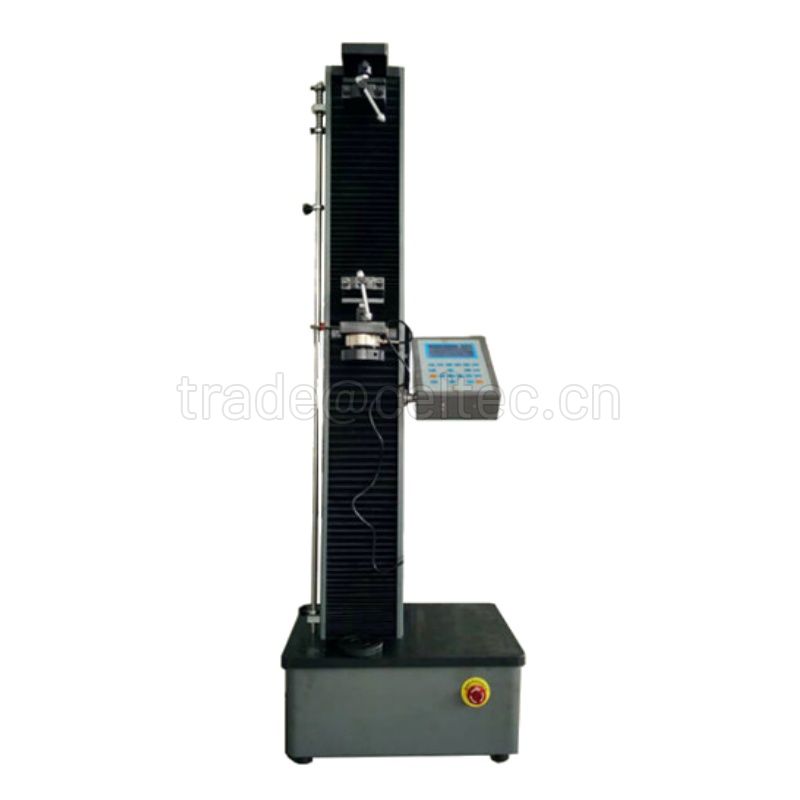
Tensile Test
Tensile testing is one of the most common tests in engineering to determine the strength properties of materials. It is done to determine the mechanical properties of isotropic materials. This test is basically based on the application of a tensile force on the specimen from opposite faces in the same direction, and monitoring the stress on the material until the material breaks. As a result of the tensile test, yield strength, maximum tensile strength, ductility, Young’s modulus, shear modulus and Poisson’s ratio of the material can be obtained.
Stress – Strain Curves
Stress and Strain Curves
The nominal tensile stress applied to the material during testing is as follows:
Where F is the tensile force and the A_0 is the cross-sectional area under tension. And the strain is defined as;
Where L_0 is the initial length of the speciemen and Δ_L is the elongation of the material after the test.
With the values derived from the test, the stress-strain curve is obtained. This curve reveals the material’s breaking point, yield strength, maximum tensile strength, and brittleness-ductility condition. Another benefit is that it gives information regardless of the material’s dimensions.
The diagram above shows the stress-strain curve of a brittle material.
For most curves, the initial part is linear. The yield strength value is obtained on the curve when a curve parallel to the slope of the curve is drawn from the point where the elongation in the stress-strain curve is 0.2%. We can determine the maximum stress a material can withstand without permanent damage using its yield strength. Up to this point, the object is in the elastic region. After this, the material enters the plastic area, where the forces placed on it cause permanent damage.
Yield Stress
The slope of the imaginary line we draw to find the yield strength gives us the Young’s modulus, which is an important material property. Young’s modulus is obtained by:
The following equation represents Poisson’s ratio, which is the negative of the ratio of horizontal displacement to vertical displacement:
Test
Most of the cross-sectional views of the specimens used in the tensile test are shown in the figure. Samples can be formed as a sheet or a cylinder.
Different clamping types may be used depending on various materials and measurement sensitivity levels. Each method of binding has advantages and disadvantages of its own.
Compression Test
The compression test demonstrates how materials behave when compressed or crushed. The test typically lasts until the substance breaks down or until a predetermined limit. The load that the material can withstand before tearing and the extent of its degradation up to this point are thus calculated. In order to test a material, it is often heated or cooled and subjected to many directions of compressive force. However, tests can be performed under varied settings.
Materials with high tensile strength generally have low compressive strength. For this reason, these materials are examined by compression testing. The materials on which the most compression tests are performed are generally brittle materials, for example, composites, concrete, wood, metal, and brick materials; polymers, plastics, and foams.
A force-strain curve is obtained as a result of the compression test. The force is then converted to stress to create a stress-strain curve. This curve is very similar to the stress-strain curve in the tensile test. Only the axes are in the direction to show the shortening.
Compression Stress – % Compression Deformation
The calculations in the tensile test are also valid for the compression test. compressive stres is expressed as;
Crushing
Crushing is used to express how much the material was shortened during the test.
Express the crushing.
Swelling
Swelling is the growth in the cross section of the material being tested. Ductile materials are more prone to swelling. It is formalized by:
Test
Brittle materials are typically the subject of compression tests. The compression characteristics of stiff foams are provided by ISO 844 as an example from the standards. The cross-sectional area values and forms, temperature-humidity values, and anticipated sample outcomes are stated in this standard. In kPa, the stresses are stated.
The compression elasticity value in the standard is as follows:
Here, σ_e, is the force at the end of the conventional elastic region, h_0 is the initial thickness of the material, and x_e is the path taken by the force generating the stress.
The following are a few of the standards developed for compression tests:
ASTM D575-91 – Standard Test Methods For Rubber Properties In Compression
ASTM E9-19 – Standard Test Methods Of Compression Testing Of Metallic Materials At Room Temperature
TS EN ISO 14126 – Fibre-reinforced plastic composites — Determination of compressive properties in the in-plane direction
Description of Technique
The evaluation of the mechanical behavior of a sample under conditions of tension and compression can be performed to provide basic material property data that is critical for component design and service performance assessment. The requirements for tensile and compression strength values and the methods for testing these properties are specified in various standards for a wide variety of materials. Testing can be performed on machined material samples or on full-size or scale models of actual components. These tests are typically performed using a universal mechanical testing instrument.
A tensile test is a method for determining behavior of materials under axial tensile loading. The tests are conducted by fixturing the specimen into the test apparatus and then applying a force to the specimen by separating the testing machine crossheads. The crosshead speed can be varied to control the rate of strain in the test specimen. Data from the test are used to determine tensile strength, yield strength, and modulus of elasticity. Measurement of the specimen dimensions after testing also provides reduction of area and elongation values to characterize the ductility of the material. Tensile tests can be performed on many materials, including metals, plastics, fibers, adhesives, and rubbers. Testing can be performed at subambient and elevated temperatures.
A compression test is a method for determining the behavior of materials under a compressive load. Compression tests are conducted by loading the test specimen between two plates, and then applying a force to the specimen by moving the crossheads together. During the test, the specimen is compressed, and deformation versus the applied load is recorded. The compression test is used to determine elastic limit, proportional limit, yield point, yield strength, and (for some materials) compressive strength.
Analytical Information
Compressive Strength – The compressive strength is the maximum compressive stress a material is capable of withstanding without fracture. Brittle materials fracture during testing and have a definite compressive strength value. The compressive strength of ductile materials is determined by their degree of distortion during testing.
Elastic Limit – Elastic limit is the maximum stress that a material can sustain without permanent deformation after removal of the stress.
Elongation – Elongation is the amount of permanent extension of a specimen that has been fractured in a tensile test.
Modules of Elasticity – The modulus of elasticity is the ratio of stress (below the proportional limit) to strain, i.e., the slope of the stress-strain curve. It is considered the measure of rigidity or stiffness of a metal.
Proportional Limit – The proportional limit is the greatest amount of stress a material is capable of reaching without deviating from the linear relation of the stress-strain curve, i.e. without developing plastic deformation.
Reduction in Area – The reduction in area is the difference between the original cross-sectional area of a tensile specimen and the smallest area at the after fracture following the test.
Strain – Strain is the amount of change in the size or shape of a material due to force.
Yield Point – The yield point is the stress in a material (usually less than the maximum attainable stress) at which an increase in strain occurs without an increase in stress. Only certain metals have a yield point.
Yield Strength – The yield strength is the stress at which a material exhibits a specified deviation from a linear stress-strain relationship. An offset of 0.2% is often used for metals.
Ultimate Tensile Strength – Ultimate tensile strength, or UTS, is the maximum tensile stress a material can sustain without fracture. It is calculated by dividing the maximum load applied during the tensile test by the original cross sectional area of the sample.
Typical Applications
Tensile and compression properties of raw material for comparison to product specifications
Obtain material property data for finite-element modeling or other product design for desired mechanical behavior and service performance
Simulation of component mechanical performance in service
Sample Requirements
Standard tensile tests on metals and plastics are conducted on specially prepared test specimens. These specimens can be machined cylindrical samples or flat plate samples (dogbone). Test samples must have a specific ratio of length to width or diameter in the test area (gage) to produce repeatable results and comply with standard test method requirements. Tubular products, fibers, and wires can be tensile tested at full size using special fixtures that promote optimal gripping and failure location.
The most common specimen used for compression testing is a right circular cylinder with flat ends. Other shapes may be used, however, they require special fixtures to avoid buckling. Special configurations for component testing or service simulations are dependent on the specific test machine to be used.
The Difference between Tensile Test and Compression Test Equipment
In the case of tensile tests, the test machine exerts a tension load or force which pulls tensile test samples apart. In the case of plastics tensile testing, the test sample is pulled apart to measure tensile strength and other properties including stiffness and yield strength. There are several common industry standards that provide agreed upon methods of plastics tensile tests. ASTM D638 and ISO 527-2 both feature similar but different standardized test sample geometry and dimensions. These tests require tensile grips that are expected to grab the sample and to adjust as it thins out during the test process. These accessories are different than compression fixtures.
In compression tests, the test machine exerts a pushing or compressive load or force to squish the test sample until it breaks or squishes. Compression tests of a polymer structural foam material is covered by ASTM D1621 which specifies the type of compression plates and deflectometer used. The test sample is placed between compression test platens until the cellular structure fails or ruptures.
A universal test machine can perform either or both tension and compression tests. The crosshead can be used to pull or compress the test sample which is located between the baseplate and the moving head.
The tensile test fixtures, or grips, and strain sensors (known as extensometer), cannot perform compression tests. Also the tensile grips are specially matched to the cover the exact test specimen geometry and dimensions. The compression test platens and deflectometer are also capable of only performing a compression test, and so both sets of accessories are needed in this case.
If you would like more information about this product, please feel free to contact us.

 Български
  English
  العربية
  Čeština
  Dansk
Dansk  Deutsch
  Ελληνικά
  Español
  Eesti
Eesti  Suomi
Suomi  Français
  Magyar
  Bahasa Indonesia
  Italiano
  日本語
日本語  한국어
한국어  Lietuvių kalba
  Latviešu valoda
  Norsk bokmål
  Nederlands
  Polski
  Português
  Română
  Русский
  Slovenčina
  Slovenščina
  Svenska
  Türkçe
  Українська